
Worsening urban heat could trigger public health meltdown, expert warns
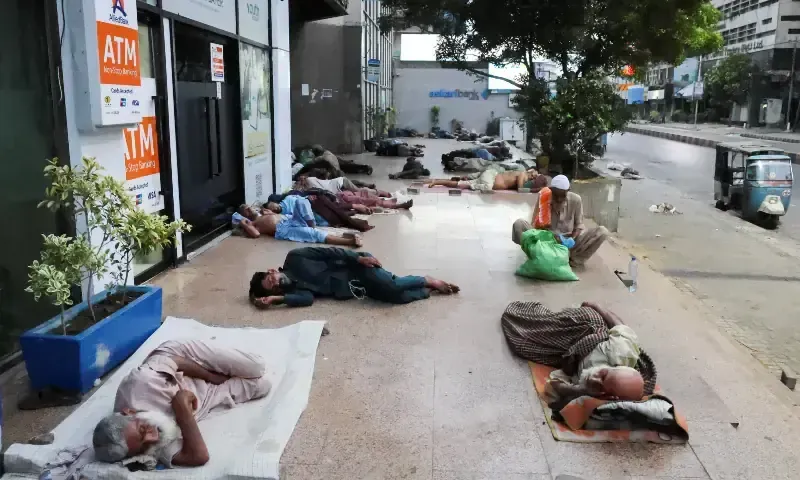
Responding to Dawn’s queries about Karachi’s challenges on the eve of World Environment Day, Prof Zafar Fatmi, Head of Environmental Occupational Health and Climate Change at the Department of Community Health Sciences, Aga Khan University, said that the city’s urban heat effect appears to be becoming more intense. He explained that more concrete, more roads, high-density construction, traffic congestion, loss of trees, and fewer open spaces are making the city absorb and retain more heat. Referring to studies conducted from Karachi, he said that they showed that urban heat island effects are present, with higher night-time land surface temperatures in urban areas, and recent work has identified heatwave vulnerability in the city’s dense urban zones.
- ▪Responding to Dawn’s queries about Karachi’s challenges on the eve of World Environment Day, Prof Zafar Fatmi, Head of Environmental Occupational Health and Climate Change at the Department of Community Health Sciences, Aga Khan University,
- ▪He explained that more concrete, more roads, high-density construction, traffic congestion, loss of trees, and fewer open spaces are making the city absorb and retain more heat.
- ▪Referring to studies conducted from Karachi, he said that they showed that urban heat island effects are present, with higher night-time land surface temperatures in urban areas, and recent work has identified heatwave vulnerability in the
Dawn files mainly under world. We currently carry 282 of its stories.
Story provenance
Source · retrieval · rights · ranking — open for full record
inspect →
Story provenance
Attribution is not the same as permission. This drawer separates discovery metadata, excerpts, WeSearch-generated summaries, reuse status, and whether the publisher receives the visit. Nothing here claims a legal grant the publisher has not made.
Record
| Original publisher | Dawn |
| Canonical URL | https://www.dawn.com/news/2005340/worsening-urban-heat-could-trigger-public-health-meltdown-expert-warns |
| Publication time | Fri, 05 Jun 2026 08:44:00 +0500 |
| Retrieval time | 2026-06-05T04:10:56.953Z |
| Last seen | 2026-06-05T04:10:58.875Z |
| Headline source | Publisher (no WeSearch rewrite) |
| Excerpt source | publisher body |
| Excerpt method | First ~120 words (~800 chars) of extracted publisher body, fair-use limited. |
| Summary | WeSearch · cerebras-chat (WeSearch summarizer) |
| Summary source text | contentText |
| Citation coverage | Summary is a WeSearch-generated derivative; primary citation is the original publisher URL. |
| Cluster | GFQMNx5LyYr9 |
| Cluster logic | Grouped by semantic title/content similarity across sources within a rolling window. Same-publisher template collisions are excluded from coverage comparison. |
| Ranking reason | Story pages are not engagement-ranked. Hub feeds use recency, with optional source-diversified chronological ordering (cap consecutive stories per source). No personalized ranking. |
| Publisher visit | Yes — open original |
| Substitutes article? | No — link-out required for full text |
Rights status (four layers)
WeSearch handling by dimension
| Indexing | May the item be indexed (stored, ranked, made findable)? | Allowed |
| Snippet | May a short excerpt of the publisher's text be shown? | Allowed |
| AI summary | May WeSearch generate its own short summary of the article? | Limited |
| Retrieval / RAG | May the content be exposed for third-party retrieval-augmented generation? | Not asserted |
| Model training | May the content be used to train AI models? | Not asserted |
| Commercial reuse | May the content be reused commercially? | Not permitted |
Basis: Derived from the published RSS/Atom feed. Contact: [email protected]. Reviewed: 2026-07-24.
Opening excerpt (first ~120 words) tap to expand
Worsening urban heat could trigger public health meltdown, expert warns Faiza Ilyas Published June 5, 2026 0 People sleep outside a business office building to escape the heat on a hot summer morning in Karachi, on May 30, 2026. — Reuters comments Join our Whatsapp Channel Add Dawn as a trusted source • Cites 2026 study that finds Karachi has highest urban-rural temperature difference• Says emergency response not enough, the city must reduce heat at its source• Links pollution, dense construction, traffic, and tree loss to growing health risks KARACHI: Highlighting the multiple environmental challenges Karachi faces, a senior community health sciences expert has called for urgent actions at both the government and individual levels to tackle the growing urban heat problem that’s silently…
Excerpt limited to ~120 words for fair-use compliance. The full article is at Dawn.