Xi closes the door after promising US CEOs to open wider

Chinese President Xi Jinping's recent actions have contradicted his earlier promises to US CEOs regarding increased openness in China's market. Instead of expanding opportunities, China is tightening controls on capital and restricting AI sector access. This shift has left US business leaders feeling disillusioned and has raised concerns about China's economic trajectory.
- ▪Xi Jinping's assurances to US CEOs about opening China's market have quickly deteriorated.
- ▪China is imposing stricter controls on cross-border capital and limiting access to its AI sector.
- ▪The CSI 300 index has underperformed compared to other Asian markets, reflecting investor concerns.
Asia Times files mainly under world. We currently carry 156 of its stories.
Story provenance
Source · retrieval · rights · ranking — open for full record
inspect →
Story provenance
Attribution is not the same as permission. This drawer separates discovery metadata, excerpts, WeSearch-generated summaries, reuse status, and whether the publisher receives the visit. Nothing here claims a legal grant the publisher has not made.
Record
| Original publisher | Asia Times |
| Canonical URL | https://asiatimes.com/2026/06/xi-closes-the-door-after-promising-us-ceos-to-open-wider/ |
| Publication time | Wed, 03 Jun 2026 07:52:52 +0000 |
| Retrieval time | 2026-06-03T07:56:59.218Z |
| Last seen | 2026-06-03T07:56:59.218Z |
| Headline source | Publisher (no WeSearch rewrite) |
| Excerpt source | publisher body |
| Excerpt method | First ~120 words (~800 chars) of extracted publisher body, fair-use limited. |
| Summary | WeSearch · cerebras-chat (WeSearch summarizer) |
| Summary source text | contentText |
| Citation coverage | Summary is a WeSearch-generated derivative; primary citation is the original publisher URL. |
| Cluster | wSgNCIvg7-2z |
| Cluster logic | Grouped by semantic title/content similarity across sources within a rolling window. Same-publisher template collisions are excluded from coverage comparison. |
| Ranking reason | Story pages are not engagement-ranked. Hub feeds use recency, with optional source-diversified chronological ordering (cap consecutive stories per source). No personalized ranking. |
| Publisher visit | Yes — open original |
| Substitutes article? | No — link-out required for full text |
Rights status (four layers)
WeSearch handling by dimension
| Indexing | May the item be indexed (stored, ranked, made findable)? | Allowed |
| Snippet | May a short excerpt of the publisher's text be shown? | Allowed |
| AI summary | May WeSearch generate its own short summary of the article? | Limited |
| Retrieval / RAG | May the content be exposed for third-party retrieval-augmented generation? | Not asserted |
| Model training | May the content be used to train AI models? | Not asserted |
| Commercial reuse | May the content be reused commercially? | Not permitted |
Basis: Derived from the published RSS/Atom feed. Contact: [email protected]. Reviewed: 2026-07-24.
Opening excerpt (first ~120 words) tap to expand
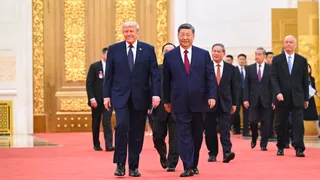
TOKYO — The billionaire CEOs who accompanied US President Donald Trump to Beijing last month are probably feeling some whiplash. Some of that disorientation comes from Trump himself — a president who built two campaigns on confronting China and has since recast himself as an open admirer of Xi Jinping, lurching between hard and soft postures with little warning. But the sharper sting is how quickly Xi’s promises have curdled. His assurances to Trump’s business entourage — that China would “open wider” and offer American firms “broader prospects” — already sound like dispatches from a different era. What was meant to inspire Apple’s Tim Cook, Tesla’s Elon Musk, Nvidia’s Jensen Huang and the other US corporate titans now looks like a head fake.
…
Excerpt limited to ~120 words for fair-use compliance. The full article is at Asia Times.
Discussion
0 commentsMore from Asia Times