
'Years to build, a moment to destroy': US and Israeli air campaign devastates some of Iran's most cherished monuments
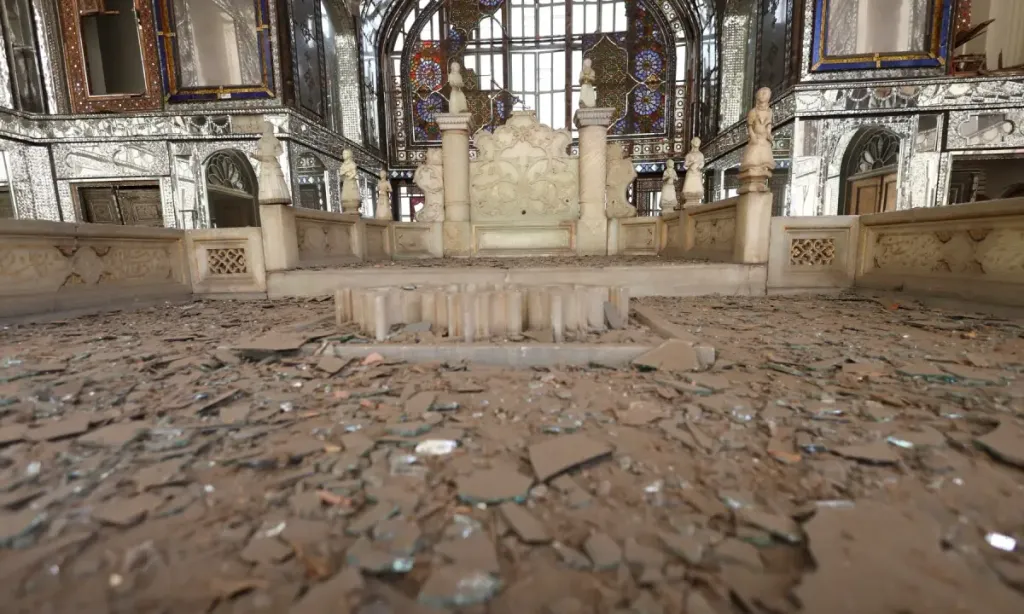
In March 2026, Israeli airstrikes targeting a governor’s office in Isfahan caused collateral damage to several UNESCO‑listed heritage sites across Iran. The blasts shattered glass, cracked walls and displaced debris in historic complexes such as Naqsh‑e Jahan Square, Chehel Sotoun Palace, Golestan Palace, as well as the Trans‑Iranian Railway and an 1,800‑year‑old fortress. UNESCO has not been consulted during the conflict and has relied on satellite imagery to verify damage at seven Iranian sites.
- ▪Airstrikes on March 7 and 9 produced shock waves that damaged eleven historic buildings, including UNESCO World Heritage sites in Isfahan and Tehran.
- ▪Damage was observed at Naqsh‑e Jahan Square, Chehel Sotoun Palace, Golestan Palace, the Jameh Mosque, the Trans‑Iranian Railway and an ancient fortress near prehistoric caves.
- ▪UNESCO reported that it was not consulted before or during the attacks and has only used satellite imagery to assess the impact.
- ▪Experts noted that the shock waves travel nearly twenty times faster than sound and can affect structures up to a kilometre from the detonation point.
- ▪The conflict marks the first recorded instance of UNESCO‑listed cultural heritage sites being damaged by US‑or allied air campaigns in the region.
Dawn files mainly under world. We currently carry 282 of its stories.
Story provenance
Source · retrieval · rights · ranking — open for full record
inspect →
Story provenance
Attribution is not the same as permission. This drawer separates discovery metadata, excerpts, WeSearch-generated summaries, reuse status, and whether the publisher receives the visit. Nothing here claims a legal grant the publisher has not made.
Record
| Original publisher | Dawn |
| Canonical URL | https://www.dawn.com/news/2011843/years-to-build-a-moment-to-destroy-us-and-israeli-air-campaign-devastates-some-of-irans-most-cherished-monuments |
| Publication time | Tue, 30 Jun 2026 12:51:09 +0500 |
| Retrieval time | 2026-06-30T07:54:24.163Z |
| Last seen | 2026-06-30T07:54:26.022Z |
| Headline source | Publisher (no WeSearch rewrite) |
| Excerpt source | publisher body |
| Excerpt method | First ~120 words (~800 chars) of extracted publisher body, fair-use limited. |
| Summary | WeSearch · cerebras-chat (WeSearch summarizer) |
| Summary source text | contentText |
| Citation coverage | Summary is a WeSearch-generated derivative; primary citation is the original publisher URL. |
| Cluster | B3J-ptI3ubeS · 2 stories |
| Cluster logic | Grouped by semantic title/content similarity across sources within a rolling window. Same-publisher template collisions are excluded from coverage comparison. |
| Ranking reason | Story pages are not engagement-ranked. Hub feeds use recency, with optional source-diversified chronological ordering (cap consecutive stories per source). No personalized ranking. |
| Publisher visit | Yes — open original |
| Substitutes article? | No — link-out required for full text |
Rights status (four layers)
WeSearch handling by dimension
| Indexing | May the item be indexed (stored, ranked, made findable)? | Allowed |
| Snippet | May a short excerpt of the publisher's text be shown? | Allowed |
| AI summary | May WeSearch generate its own short summary of the article? | Limited |
| Retrieval / RAG | May the content be exposed for third-party retrieval-augmented generation? | Not asserted |
| Model training | May the content be used to train AI models? | Not asserted |
| Commercial reuse | May the content be reused commercially? | Not permitted |
Basis: Derived from the published RSS/Atom feed. Contact: [email protected]. Reviewed: 2026-07-24.
Opening excerpt (first ~120 words) tap to expand
Debris covers the floor around the Takht-e Marmar (Marble Throne) inside the Hall of Mirrors (Talar-e Ayne) at Golestan Palace, a Unesco World Heritage site, amid the US-Israeli conflict with Iran, in Tehran, Iran, on March 21, 2026. — Reuters 'Years to build, a moment to destroy': US-Israeli air campaign devastates some of Iran's most cherished monuments Ranging from shattered glass and broken tile to cracked walls and shaken foundations, the damage is mostly inflicted by bomb shock waves radiating out nearly 20 times faster than the speed of sound. Reuters Published June 30, 2026 Listen to article 1x 1.2x 1.5x A first set of blast waves set ancient domes and minarets trembling around the most famous square in the ancient city of Isfahan.
…
Excerpt limited to ~120 words for fair-use compliance. The full article is at Dawn.