Your Python Scraper Has a Tell. Curl-Cffi Is How You Hide It
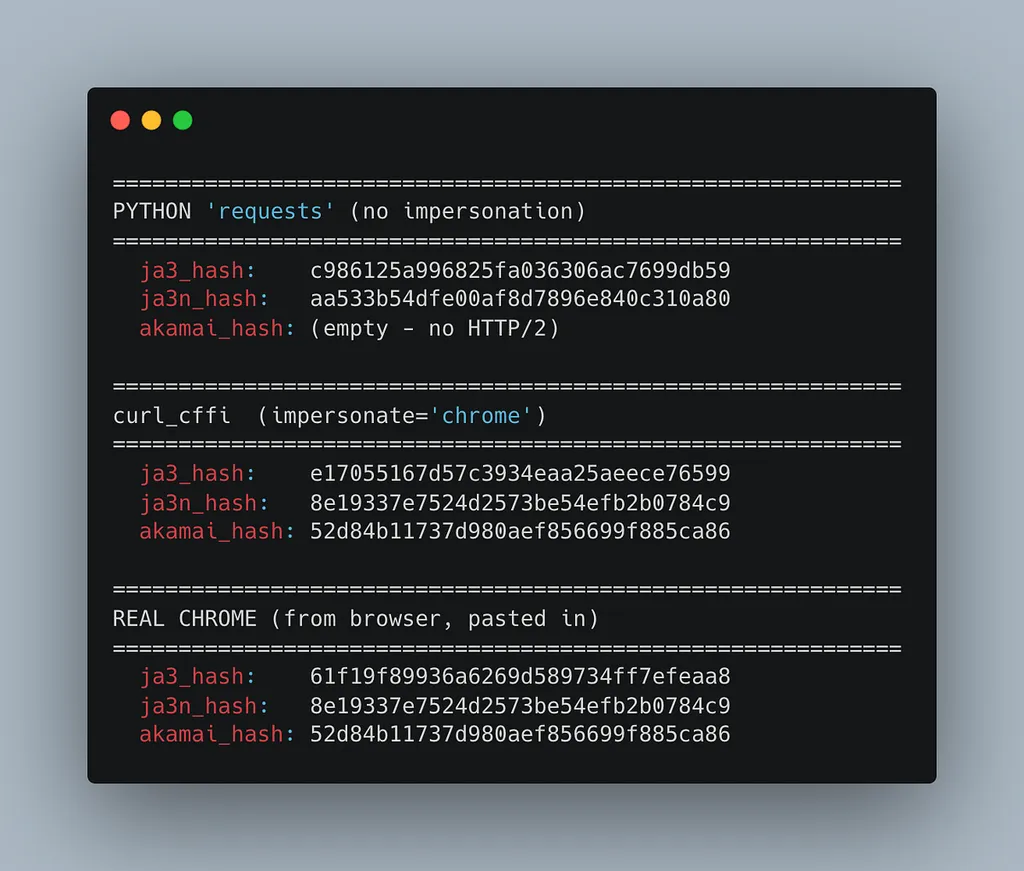
Python scrapers can be identified by their unique TLS fingerprint, which is sent before any HTTPS data is transmitted. This fingerprint can be used by websites to block scrapers, even if they are using rotating User-Agents and residential proxies. The curl-cffi library can be used to mimic the TLS and HTTP/2 fingerprints of real browsers, making it harder for websites to detect scrapers.
- ▪The TLS ClientHello message is sent by the TLS client before any HTTPS data is transmitted and can be used to identify the client.
- ▪The JA3 fingerprint is a hash of the TLS ClientHello message and can be used to identify the client.
- ▪The curl-cffi library can be used to rewrite the TLS ClientHello message to match that of a real browser.
2 outlets in our directory ran this story, first to last over 1 hour. All of the coverage we found sits in one bucket: centre. That one-sidedness is itself worth noticing.
- ▪ Your Python Scraper Has a Tell. curl-cffi Is How You Hide It — r/programming
Hacker News (Newest) files mainly under programming. We currently carry 5,306 of its stories.
Story provenance
Source · retrieval · rights · ranking — open for full record
inspect →
Story provenance
Attribution is not the same as permission. This drawer separates discovery metadata, excerpts, WeSearch-generated summaries, reuse status, and whether the publisher receives the visit. Nothing here claims a legal grant the publisher has not made.
Record
| Original publisher | Medium |
| Canonical URL | https://medium.com/@farbodkhorramvatan/your-python-scraper-has-a-tell-curl-cffi-is-how-you-hide-it-3f4ebd02516f |
| Publication time | Tue, 26 May 2026 08:24:42 +0000 |
| Retrieval time | 2026-05-26T08:37:47.354Z |
| Last seen | 2026-05-26T08:37:51.564Z |
| Headline source | Publisher (no WeSearch rewrite) |
| Excerpt source | publisher body |
| Excerpt method | First ~120 words (~800 chars) of extracted publisher body, fair-use limited. |
| Summary | WeSearch · cerebras-chat (WeSearch summarizer) |
| Summary source text | contentText |
| Citation coverage | Summary is a WeSearch-generated derivative; primary citation is the original publisher URL. |
| Cluster | YJcG7AonyHoo · 2 stories |
| Cluster logic | Grouped by semantic title/content similarity across sources within a rolling window. Same-publisher template collisions are excluded from coverage comparison. |
| Ranking reason | Story pages are not engagement-ranked. Hub feeds use recency, with optional source-diversified chronological ordering (cap consecutive stories per source). No personalized ranking. |
| Publisher visit | Yes — open original |
| Substitutes article? | No — link-out required for full text |
Rights status (four layers)
WeSearch handling by dimension
| Indexing | May the item be indexed (stored, ranked, made findable)? | Allowed |
| Snippet | May a short excerpt of the publisher's text be shown? | Allowed |
| AI summary | May WeSearch generate its own short summary of the article? | Limited |
| Retrieval / RAG | May the content be exposed for third-party retrieval-augmented generation? | Not asserted |
| Model training | May the content be used to train AI models? | Not asserted |
| Commercial reuse | May the content be reused commercially? | Not permitted |
Basis: Derived from the published RSS/Atom feed. Contact: [email protected]. Reviewed: 2026-07-24.
Opening excerpt (first ~120 words) tap to expand
Your Python Scraper Has a Tell. curl-cffi Is How You Hide It.The invisible fingerprint every requests call leaves behind — and here’s how you can fix it.Farbod Khorramvatan8 min read·May 25, 2026--ListenShareYou spent three hours crafting the perfect request. Rotating User-Agents. Real browser headers copied straight from DevTools. Residential proxies on top.And the site still hands you a 403. Or worse — a 200 with a Cloudflare challenge page that your code happily parses as "success."So you do what most scrapers eventually do. You reach for Selenium. You spin up a headless browser. You watch your memory climb past a gigabyte to fetch a JSON endpoint that should have taken 200 milliseconds.Here’s the uncomfortable truth I had to swallow: the site wasn’t blocking my headers.
…
Excerpt limited to ~120 words for fair-use compliance. The full article is at Medium.
Discussion
0 commentsMore from Medium