AI 'Raygun' can shrink and supersize proteins – enabling easy editing
Researchers have developed an AI tool called Raygun that can shrink or supersize proteins without disrupting their shape or function. This tool uses a mathematical approach to modify existing proteins, allowing for easy editing and potential applications in biotechnology. The study, published in Nature, demonstrates the potential of Raygun to create smaller or larger versions of existing proteins, which could be useful in various fields.
- ▪The AI tool Raygun can modify existing proteins by adding, deleting, or substituting protein subunits.
- ▪Raygun uses a mathematical approach to create a standardized version of the protein, allowing it to generate proteins at various sizes without compromising their structural integrity.
- ▪The tool has the potential to enable easy editing of proteins, which could be useful in biotechnology applications.
Hacker News (AI / LLM) files mainly under ai. We currently carry 3,307 of its stories.
Story provenance
Source · retrieval · rights · ranking — open for full record
inspect →
Story provenance
Attribution is not the same as permission. This drawer separates discovery metadata, excerpts, WeSearch-generated summaries, reuse status, and whether the publisher receives the visit. Nothing here claims a legal grant the publisher has not made.
Record
| Original publisher | Nature |
| Canonical URL | https://www.nature.com/articles/d41586-026-02335-5 |
| Publication time | Wed, 29 Jul 2026 17:26:39 +0000 |
| Retrieval time | 2026-07-29T17:46:07.586Z |
| Last seen | 2026-07-29T17:46:07.586Z |
| Headline source | Publisher (no WeSearch rewrite) |
| Excerpt source | publisher body |
| Excerpt method | First ~120 words (~800 chars) of extracted publisher body, fair-use limited. |
| Summary | WeSearch · cerebras-chat (WeSearch summarizer) |
| Summary source text | contentText |
| Citation coverage | Summary is a WeSearch-generated derivative; primary citation is the original publisher URL. |
| Cluster | yJH__UQkEl-X |
| Cluster logic | Grouped by semantic title/content similarity across sources within a rolling window. Same-publisher template collisions are excluded from coverage comparison. |
| Ranking reason | Story pages are not engagement-ranked. Hub feeds use recency, with optional source-diversified chronological ordering (cap consecutive stories per source). No personalized ranking. |
| Publisher visit | Yes — open original |
| Substitutes article? | No — link-out required for full text |
Rights status (four layers)
WeSearch handling by dimension
| Indexing | May the item be indexed (stored, ranked, made findable)? | Allowed |
| Snippet | May a short excerpt of the publisher's text be shown? | Allowed |
| AI summary | May WeSearch generate its own short summary of the article? | Limited |
| Retrieval / RAG | May the content be exposed for third-party retrieval-augmented generation? | Not asserted |
| Model training | May the content be used to train AI models? | Not asserted |
| Commercial reuse | May the content be reused commercially? | Not permitted |
Basis: Derived from the published RSS/Atom feed. Contact: [email protected]. Reviewed: 2026-07-24.
Opening excerpt (first ~120 words) tap to expand
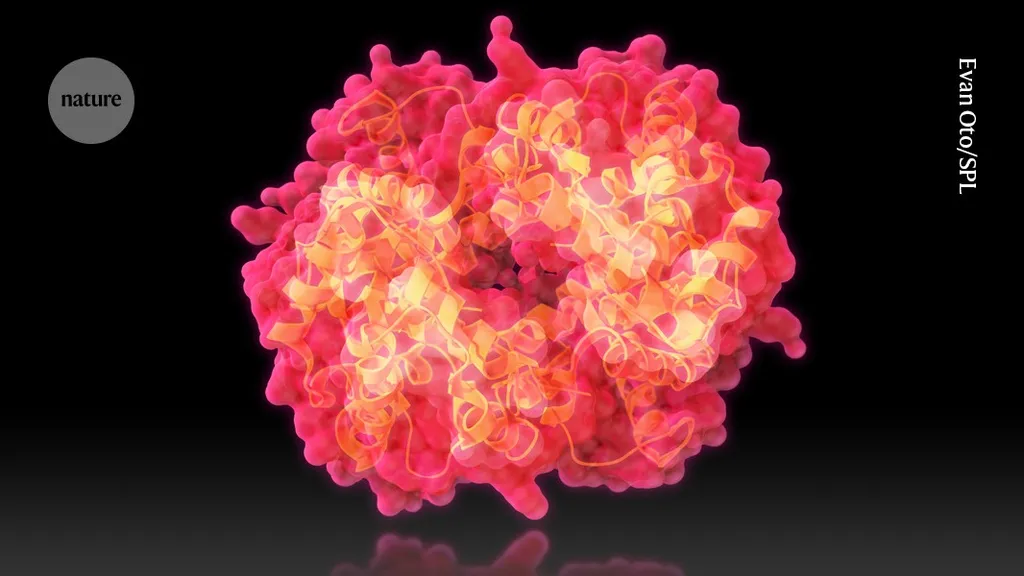
NEWS 29 July 2026 This AI ‘Raygun’ can shrink and supersize proteins — opening the door to easy editing Model modifies existing proteins using probability approach. By Gemma Conroy0 Gemma Conroy Gemma Conroy is a freelance science journalist in Mexico City. View author publications Search author on: PubMed Google Scholar Email Bluesky Facebook LinkedIn Reddit Whatsapp X The protein haemoglobin (artist’s illustration) can be miniaturized by an AI tool called Raygun.Credit: Evan Oto/SPLA sci-fi weapon has entered the AI age. A artificial-intelligence tool dubbed Raygun can miniaturize or supersize a natural protein without disrupting the protein’s shape or ability to function1.Scientist have developed a host of AI ‘protein language models’ that can create proteins from scratch.
…
Excerpt limited to ~120 words for fair-use compliance. The full article is at Nature.
Discussion
0 commentsMore from Nature
![Book of Cron Job [fiction]](/img-proxy?url=https%3A%2F%2Fmedia.nature.com%2Flw1200%2Fmagazine-assets%2Fd41586-026-01716-0%2Fd41586-026-01716-0_52500258.jpg&w=320)