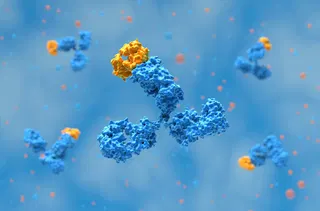
Chemical bonds emerge naturally from maximally entangled atomic orbitals

A new framework for understanding chemical bonding has been proposed, utilizing maximally entangled atomic orbitals (MEAOs). This approach links chemical bonding to quantum information concepts, providing a clearer perspective on bond strength and structure. The framework is applicable to both equilibrium geometries and transition states in chemical reactions.
- ▪Chemical bonding is characterized through the concept of orbital entanglement.
- ▪Maximally entangled atomic orbitals recover both Lewis and beyond-Lewis structures.
- ▪The framework offers a quantitative descriptor for bond strength and can enhance existing theories of atoms in molecules.
Hacker News (Newest) files mainly under programming. We currently carry 5,306 of its stories.
Story provenance
Source · retrieval · rights · ranking — open for full record
inspect →
Story provenance
Attribution is not the same as permission. This drawer separates discovery metadata, excerpts, WeSearch-generated summaries, reuse status, and whether the publisher receives the visit. Nothing here claims a legal grant the publisher has not made.
Record
| Original publisher | Nature |
| Canonical URL | https://www.nature.com/articles/s41467-026-73527-w |
| Publication time | Fri, 29 May 2026 02:12:28 +0000 |
| Retrieval time | 2026-05-29T02:29:40.923Z |
| Last seen | 2026-05-29T02:29:40.923Z |
| Headline source | Publisher (no WeSearch rewrite) |
| Excerpt source | publisher body |
| Excerpt method | First ~120 words (~800 chars) of extracted publisher body, fair-use limited. |
| Summary | WeSearch · cerebras-chat (WeSearch summarizer) |
| Summary source text | contentText |
| Citation coverage | Summary is a WeSearch-generated derivative; primary citation is the original publisher URL. |
| Cluster | HCmYILkzupaU |
| Cluster logic | Grouped by semantic title/content similarity across sources within a rolling window. Same-publisher template collisions are excluded from coverage comparison. |
| Ranking reason | Story pages are not engagement-ranked. Hub feeds use recency, with optional source-diversified chronological ordering (cap consecutive stories per source). No personalized ranking. |
| Publisher visit | Yes — open original |
| Substitutes article? | No — link-out required for full text |
Rights status (four layers)
WeSearch handling by dimension
| Indexing | May the item be indexed (stored, ranked, made findable)? | Allowed |
| Snippet | May a short excerpt of the publisher's text be shown? | Allowed |
| AI summary | May WeSearch generate its own short summary of the article? | Limited |
| Retrieval / RAG | May the content be exposed for third-party retrieval-augmented generation? | Not asserted |
| Model training | May the content be used to train AI models? | Not asserted |
| Commercial reuse | May the content be reused commercially? | Not permitted |
Basis: Derived from the published RSS/Atom feed. Contact: [email protected]. Reviewed: 2026-07-24.
Opening excerpt (first ~120 words) tap to expand
Download PDF Article Open access Published: 27 May 2026 Chemical bonding concepts emerge naturally from maximally entangled atomic orbitals Lexin Ding1,2, Eduard Matito3,4,5 & Christian Schilling ORCID: orcid.org/0000-0001-6781-41111,2 Nature Communications volume 17, Article number: 4732 (2026) Cite this article 22 Altmetric Metrics details Subjects Quantum chemistryQuantum information AbstractChemical bonding is a nonlocal phenomenon that binds atoms into molecules. Its ubiquitous presence in chemistry, however, stands in stark contrast to its ambiguous definition and the lack of a universal perspective for its understanding. In this work, we rationalize and characterize chemical bonding through the lens of an equally nonlocal concept from quantum information, the orbital entanglement.
…
Excerpt limited to ~120 words for fair-use compliance. The full article is at Nature.
Discussion
0 commentsMore from Nature
![Book of Cron Job [fiction]](/img-proxy?url=https%3A%2F%2Fmedia.nature.com%2Flw1200%2Fmagazine-assets%2Fd41586-026-01716-0%2Fd41586-026-01716-0_52500258.jpg&w=320)