Astronomers Think They've Detected Antimatter Signals From Beyond The Milky Way For The First Time
The typical idea of antimatter that is just violently destroying matter everywhere is not the case in space. That escape was basically unexpected."The Magellanic Stream. (David L. The strongest signal reached 4 sigma, which means there's a roughly one-in-15,000 chance it emerged from a statistical fluctuation.
- ▪The typical idea of antimatter that is just violently destroying matter everywhere is not the case in space.
- ▪That escape was basically unexpected."The Magellanic Stream. (David L.
- ▪The strongest signal reached 4 sigma, which means there's a roughly one-in-15,000 chance it emerged from a statistical fluctuation.
ScienceAlert files mainly under news. We currently carry 8 of its stories.
Story provenance
Source · retrieval · rights · ranking — open for full record
inspect →
Story provenance
Attribution is not the same as permission. This drawer separates discovery metadata, excerpts, WeSearch-generated summaries, reuse status, and whether the publisher receives the visit. Nothing here claims a legal grant the publisher has not made.
Record
| Original publisher | ScienceAlert |
| Canonical URL | https://www.sciencealert.com/strange-gamma-rays-beyond-the-milky-way-may-reveal-antimatter-annihilation |
| Publication time | Sat, 25 Jul 2026 19:00:00 +0000 |
| Retrieval time | 2026-07-25T21:18:45.334Z |
| Last seen | 2026-07-25T21:18:45.334Z |
| Headline source | Publisher (no WeSearch rewrite) |
| Excerpt source | publisher body |
| Excerpt method | First ~120 words (~800 chars) of extracted publisher body, fair-use limited. |
| Summary | WeSearch · cerebras-chat (WeSearch summarizer) |
| Summary source text | contentText |
| Citation coverage | Summary is a WeSearch-generated derivative; primary citation is the original publisher URL. |
| Cluster | ApCZn_Wko4B- |
| Cluster logic | Grouped by semantic title/content similarity across sources within a rolling window. Same-publisher template collisions are excluded from coverage comparison. |
| Ranking reason | Story pages are not engagement-ranked. Hub feeds use recency, with optional source-diversified chronological ordering (cap consecutive stories per source). No personalized ranking. |
| Publisher visit | Yes — open original |
| Substitutes article? | No — link-out required for full text |
Rights status (four layers)
WeSearch handling by dimension
| Indexing | May the item be indexed (stored, ranked, made findable)? | Allowed |
| Snippet | May a short excerpt of the publisher's text be shown? | Allowed |
| AI summary | May WeSearch generate its own short summary of the article? | Limited |
| Retrieval / RAG | May the content be exposed for third-party retrieval-augmented generation? | Not asserted |
| Model training | May the content be used to train AI models? | Not asserted |
| Commercial reuse | May the content be reused commercially? | Not permitted |
Basis: Derived from the published RSS/Atom feed. Contact: [email protected]. Reviewed: 2026-07-24.
Opening excerpt (first ~120 words) tap to expand
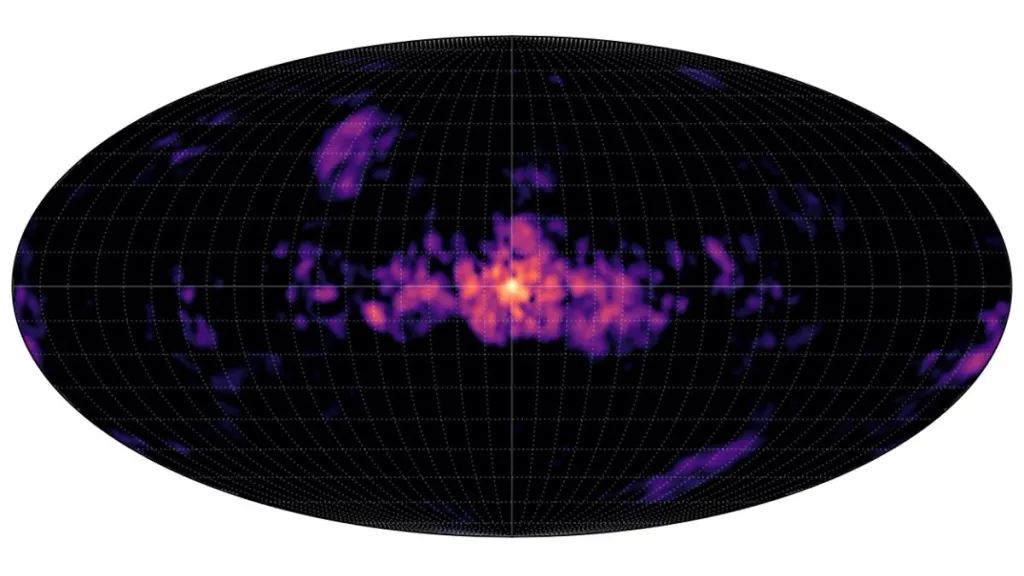
Astronomers Think They've Detected Antimatter Signals From Beyond The Milky Way For The First Time Space26 July 2026By Michelle Starr Add ScienceAlert on Google The 20-year 511 keV map from the INTEGRAL gamma-ray space telescope. (Yoneda et al., A&A, 2025) There's something wrong with the center of the Milky Way.For decades, astronomers have puzzled over a vast population of antimatter particles, or positrons, that collide with electrons to annihilate in flashes of gamma rays around the center of our galaxy.
…
Excerpt limited to ~120 words for fair-use compliance. The full article is at ScienceAlert.
Discussion
0 commentsMore from ScienceAlert