Breaking Enigma with an FPGA, Just like at Bletchly Park
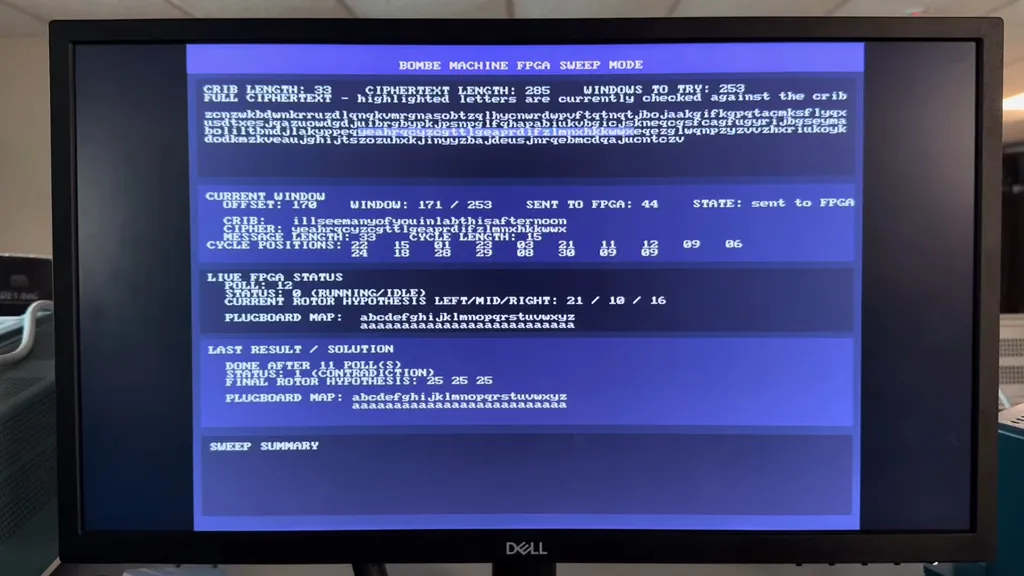
A student project at Cornell University has successfully emulated the Bletchley Park cryptography apparatus using an FPGA. The project, undertaken by Erica Jiang, Kelvin Resch, and Isabella Frank, showcases the capabilities of modern technology in breaking historical codes. This initiative not only honors the legacy of Alan Turing but also serves as an educational tool for understanding cryptography.
- ▪The project emulates the entire Bletchley Park cryptography apparatus, not just the Bombe Machine.
- ▪FPGA technology allows for faster execution of fixed logic compared to traditional CPUs.
- ▪The students' work serves as a great learning opportunity and pays homage to historical cryptography efforts.
Hackaday files mainly under tech. We currently carry 244 of its stories.
Story provenance
Source · retrieval · rights · ranking — open for full record
inspect →
Story provenance
Attribution is not the same as permission. This drawer separates discovery metadata, excerpts, WeSearch-generated summaries, reuse status, and whether the publisher receives the visit. Nothing here claims a legal grant the publisher has not made.
Record
| Original publisher | Hackaday |
| Canonical URL | https://hackaday.com/2026/05/30/breaking-enigma-with-an-fpga-just-like-at-bletchly-park/ |
| Publication time | Sat, 30 May 2026 20:00:07 +0000 |
| Retrieval time | 2026-05-30T20:04:45.468Z |
| Last seen | 2026-05-30T20:04:45.468Z |
| Headline source | Publisher (no WeSearch rewrite) |
| Excerpt source | publisher body |
| Excerpt method | First ~120 words (~800 chars) of extracted publisher body, fair-use limited. |
| Summary | WeSearch · cerebras-chat (WeSearch summarizer) |
| Summary source text | contentText |
| Citation coverage | Summary is a WeSearch-generated derivative; primary citation is the original publisher URL. |
| Cluster | IaKt7wc8ALRa |
| Cluster logic | Grouped by semantic title/content similarity across sources within a rolling window. Same-publisher template collisions are excluded from coverage comparison. |
| Ranking reason | Story pages are not engagement-ranked. Hub feeds use recency, with optional source-diversified chronological ordering (cap consecutive stories per source). No personalized ranking. |
| Publisher visit | Yes — open original |
| Substitutes article? | No — link-out required for full text |
Rights status (four layers)
WeSearch handling by dimension
| Indexing | May the item be indexed (stored, ranked, made findable)? | Allowed |
| Snippet | May a short excerpt of the publisher's text be shown? | Allowed |
| AI summary | May WeSearch generate its own short summary of the article? | Limited |
| Retrieval / RAG | May the content be exposed for third-party retrieval-augmented generation? | Not asserted |
| Model training | May the content be used to train AI models? | Not asserted |
| Commercial reuse | May the content be reused commercially? | Not permitted |
Basis: Derived from the published RSS/Atom feed. Contact: [email protected]. Reviewed: 2026-07-24.
Opening excerpt (first ~120 words) tap to expand
Breaking Enigma With An FPGA, Just Like At Bletchly Park No comments by: Tyler August May 30, 2026 Title: Copy Short Link: Copy The pioneering work done by Alan Turing and others at Bletchley Park in England was perhaps as important in the history of technology as it was the history of the war. Given the last 80-odd years of technological development, their revolutionary work should be within the realms of a student project — which it was, specifically in ECE 5760 at Cornell University. The work was done by [Erica Jiang], [Kelvin Resch], and [Isabella Frank]. Nowadays if someone told you there was a code to be broken, you wouldn’t be reaching for electromechanical devices, but you just might think of trying an FPGA.
…
Excerpt limited to ~120 words for fair-use compliance. The full article is at Hackaday.
Discussion
0 commentsMore from Hackaday