ESP-Osito Eschews Retrocomputing for Modern Code on Modern, Equivalent Hardware
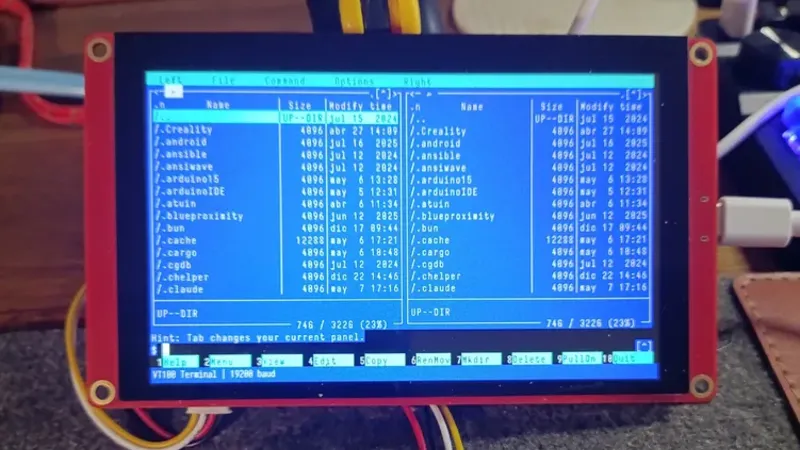
Roberto Alsina has developed an operating system called ESP-Osito for the Cheap Yellow Display, which he describes as the cheapest computer. The OS allows for quick app loading and simple app creation, reminiscent of 90s-era computers but with modern capabilities. While it lacks multitasking, the user experience is enhanced by fast app performance and a variety of applications, including a weather clock and a chat app connected to an LLM.
- ▪ESP-Osito is designed for the Cheap Yellow Display, which Alsina refers to as the cheapest computer.
- ▪The operating system allows for quick app loading and easy app creation in a few hundred lines of C.
- ▪Despite lacking multitasking, the OS offers a user experience similar to 90s computers with modern features.
Hackaday files mainly under tech. We currently carry 248 of its stories.
Story provenance
Source · retrieval · rights · ranking — open for full record
inspect →
Story provenance
Attribution is not the same as permission. This drawer separates discovery metadata, excerpts, WeSearch-generated summaries, reuse status, and whether the publisher receives the visit. Nothing here claims a legal grant the publisher has not made.
Record
| Original publisher | Hackaday |
| Canonical URL | https://hackaday.com/2026/05/29/esp-osito-eschews-retrocomputing-for-modern-code-on-modern-equivalent-hardware/ |
| Publication time | Fri, 29 May 2026 23:00:44 +0000 |
| Retrieval time | 2026-05-29T23:05:36.214Z |
| Last seen | 2026-05-29T23:05:36.214Z |
| Headline source | Publisher (no WeSearch rewrite) |
| Excerpt source | publisher body |
| Excerpt method | First ~120 words (~800 chars) of extracted publisher body, fair-use limited. |
| Summary | WeSearch · cerebras-chat (WeSearch summarizer) |
| Summary source text | contentText |
| Citation coverage | Summary is a WeSearch-generated derivative; primary citation is the original publisher URL. |
| Cluster | ZOSM1cXPOpuz |
| Cluster logic | Grouped by semantic title/content similarity across sources within a rolling window. Same-publisher template collisions are excluded from coverage comparison. |
| Ranking reason | Story pages are not engagement-ranked. Hub feeds use recency, with optional source-diversified chronological ordering (cap consecutive stories per source). No personalized ranking. |
| Publisher visit | Yes — open original |
| Substitutes article? | No — link-out required for full text |
Rights status (four layers)
WeSearch handling by dimension
| Indexing | May the item be indexed (stored, ranked, made findable)? | Allowed |
| Snippet | May a short excerpt of the publisher's text be shown? | Allowed |
| AI summary | May WeSearch generate its own short summary of the article? | Limited |
| Retrieval / RAG | May the content be exposed for third-party retrieval-augmented generation? | Not asserted |
| Model training | May the content be used to train AI models? | Not asserted |
| Commercial reuse | May the content be reused commercially? | Not permitted |
Basis: Derived from the published RSS/Atom feed. Contact: [email protected]. Reviewed: 2026-07-24.
Opening excerpt (first ~120 words) tap to expand
ESP-Osito Eschews Retrocomputing For Modern Code On Modern, Equivalent Hardware No comments by: Tyler August May 29, 2026 Title: Copy Short Link: Copy If you’re of a certain vintage, you have probably looked at some of the microcomputers on the market these days and thought “that would have been a decent workstation back in the day!”. We certianly have, and so did [Roberto Alsina]. Rather than allow himself to contemplate his age and threfore rapidly approaching mortailty, [Roberto] wrote a useful operating system called ESP-Osito for the Cheap Yellow Display, which he refers to as “the cheapest computer”. He’s not wrong, and it’s certainly a better use of time than an existential crisis.
…
Excerpt limited to ~120 words for fair-use compliance. The full article is at Hackaday.
Discussion
0 commentsMore from Hackaday