semab tariq: How to Cut Over After a PostgreSQL Migration
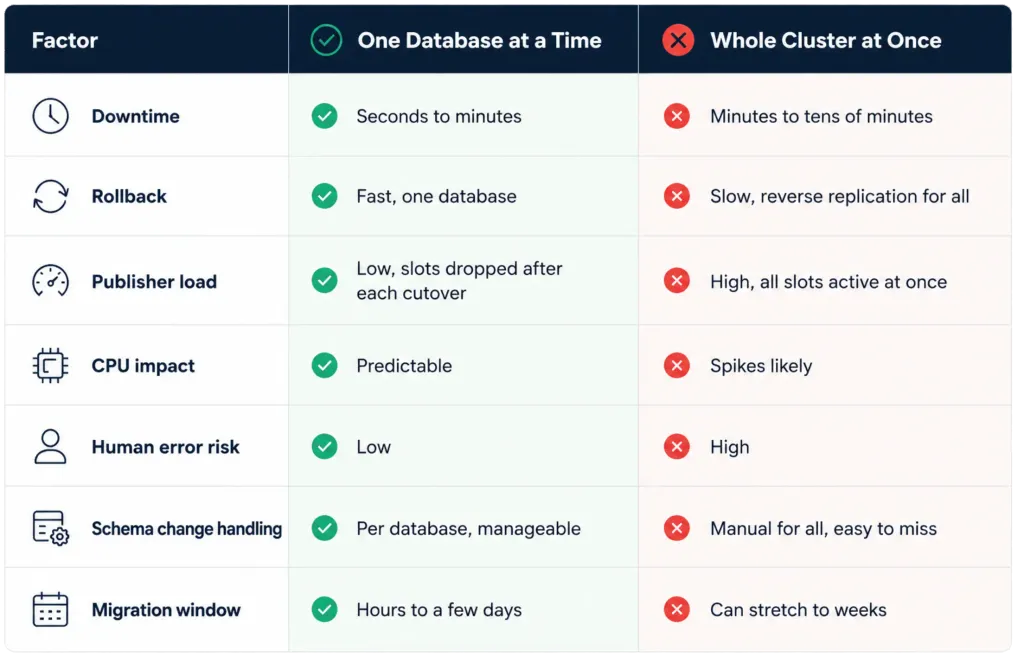
The article discusses strategies for cutting over after a PostgreSQL migration. It outlines two main approaches: migrating one database at a time or migrating the entire cluster at once. Each method has its advantages and challenges, with the first approach generally being easier to manage and less prone to errors.
- ▪Cutting over one database at a time allows for focused management and quicker identification of issues.
- ▪This approach reduces the risk of overwhelming the system with replication slots and CPU load.
- ▪Migrating the entire cluster at once can lead to complex challenges and increased resource demands.
Planet PostgreSQL files mainly under programming. We currently carry 28 of its stories.
Story provenance
Source · retrieval · rights · ranking — open for full record
inspect →
Story provenance
Attribution is not the same as permission. This drawer separates discovery metadata, excerpts, WeSearch-generated summaries, reuse status, and whether the publisher receives the visit. Nothing here claims a legal grant the publisher has not made.
Record
| Original publisher | Stormatics |
| Canonical URL | https://postgr.es/p/9jA |
| Publication time | Thu, 21 May 2026 10:39:08 +0000 |
| Retrieval time | 2026-05-21T10:51:10.728Z |
| Last seen | 2026-05-21T10:51:10.728Z |
| Headline source | Publisher (no WeSearch rewrite) |
| Excerpt source | publisher body |
| Excerpt method | First ~120 words (~800 chars) of extracted publisher body, fair-use limited. |
| Summary | WeSearch · cerebras-chat (WeSearch summarizer) |
| Summary source text | contentText |
| Citation coverage | Summary is a WeSearch-generated derivative; primary citation is the original publisher URL. |
| Cluster | q5TCwmqrWCDk |
| Cluster logic | Grouped by semantic title/content similarity across sources within a rolling window. Same-publisher template collisions are excluded from coverage comparison. |
| Ranking reason | Story pages are not engagement-ranked. Hub feeds use recency, with optional source-diversified chronological ordering (cap consecutive stories per source). No personalized ranking. |
| Publisher visit | Yes — open original |
| Substitutes article? | No — link-out required for full text |
Rights status (four layers)
WeSearch handling by dimension
| Indexing | May the item be indexed (stored, ranked, made findable)? | Allowed |
| Snippet | May a short excerpt of the publisher's text be shown? | Allowed |
| AI summary | May WeSearch generate its own short summary of the article? | Limited |
| Retrieval / RAG | May the content be exposed for third-party retrieval-augmented generation? | Not asserted |
| Model training | May the content be used to train AI models? | Not asserted |
| Commercial reuse | May the content be reused commercially? | Not permitted |
Basis: Derived from the published RSS/Atom feed. Contact: [email protected]. Reviewed: 2026-07-24.
Opening excerpt (first ~120 words) tap to expand
May 21, 2026By Semab TariqBlog, Semab's Planet PostgreSQL How to Cut Over After a PostgreSQL Migration One Database at a Time, or All at Once?You have deployed your new cluster. Now comes the work of moving your data and cutting over to it. Reading that sentence, you might assume cutover is something you figure out at the end, after the migration is done. And in practice, that is the order in which things happen. But technically, it is your cutover strategy that decides how you migrate, not the other way around. The strategy you pick determines how you configure replication, how many slots you provision, how you handle schema changes, and what your rollback path looks like. So before you touch replication, decide how you want to cut over.
…
Excerpt limited to ~120 words for fair-use compliance. The full article is at Stormatics.
Discussion
0 commentsMore from Stormatics