The Maths Behind A Chord Recognition Engine
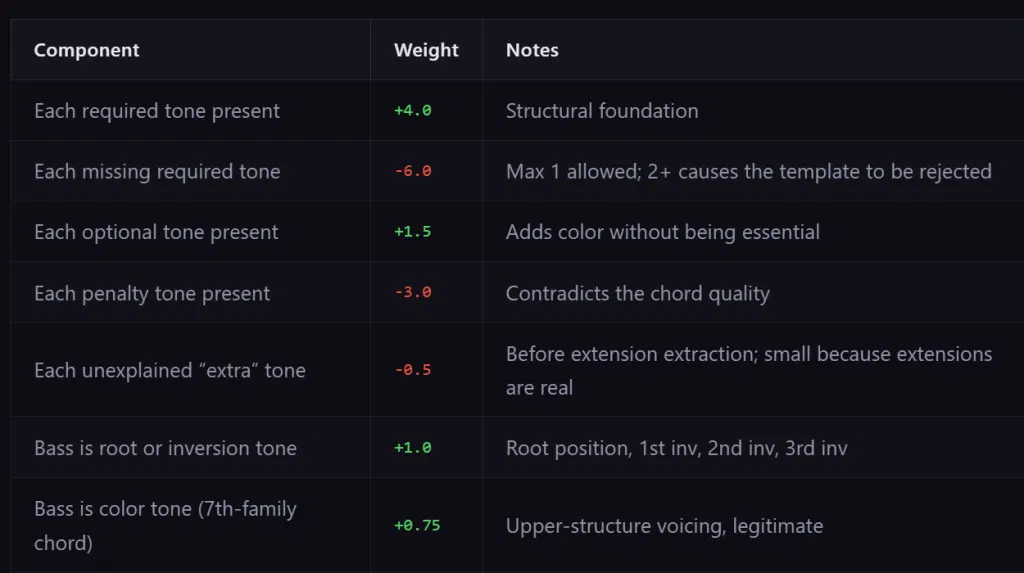
The article discusses the development of the WhatChord tool, which helps identify musical chords programmatically. It explains the challenges of chord classification due to the varied ways musicians construct and name chords. WhatChord uses a scoring algorithm to evaluate the presence of specific notes and determine the most likely chord.
- ▪WhatChord is a tool designed to identify musical chords from their component notes.
- ▪The tool uses a scoring algorithm that weights required notes and penalizes incorrect ones.
- ▪It accounts for various musical contexts and ambiguous tones to improve accuracy.
Hackaday files mainly under tech. We currently carry 243 of its stories.
Story provenance
Source · retrieval · rights · ranking — open for full record
inspect →
Story provenance
Attribution is not the same as permission. This drawer separates discovery metadata, excerpts, WeSearch-generated summaries, reuse status, and whether the publisher receives the visit. Nothing here claims a legal grant the publisher has not made.
Record
| Original publisher | Hackaday |
| Canonical URL | https://hackaday.com/2026/05/22/the-maths-behind-a-chord-recognition-engine/ |
| Publication time | Sat, 23 May 2026 02:00:36 +0000 |
| Retrieval time | 2026-05-23T02:02:03.837Z |
| Last seen | 2026-05-23T02:02:03.837Z |
| Headline source | Publisher (no WeSearch rewrite) |
| Excerpt source | publisher body |
| Excerpt method | First ~120 words (~800 chars) of extracted publisher body, fair-use limited. |
| Summary | WeSearch · cerebras-chat (WeSearch summarizer) |
| Summary source text | contentText |
| Citation coverage | Summary is a WeSearch-generated derivative; primary citation is the original publisher URL. |
| Cluster | lXacMFn0zgOW |
| Cluster logic | Grouped by semantic title/content similarity across sources within a rolling window. Same-publisher template collisions are excluded from coverage comparison. |
| Ranking reason | Story pages are not engagement-ranked. Hub feeds use recency, with optional source-diversified chronological ordering (cap consecutive stories per source). No personalized ranking. |
| Publisher visit | Yes — open original |
| Substitutes article? | No — link-out required for full text |
Rights status (four layers)
WeSearch handling by dimension
| Indexing | May the item be indexed (stored, ranked, made findable)? | Allowed |
| Snippet | May a short excerpt of the publisher's text be shown? | Allowed |
| AI summary | May WeSearch generate its own short summary of the article? | Limited |
| Retrieval / RAG | May the content be exposed for third-party retrieval-augmented generation? | Not asserted |
| Model training | May the content be used to train AI models? | Not asserted |
| Commercial reuse | May the content be reused commercially? | Not permitted |
Basis: Derived from the published RSS/Atom feed. Contact: [email protected]. Reviewed: 2026-07-24.
Opening excerpt (first ~120 words) tap to expand
The Maths Behind A Chord Recognition Engine No comments by: Zoe Skyforest May 22, 2026 Title: Copy Short Link: Copy A key part of any tertiary musical education is learning about all the wonderful (and less wonderful) types of chords out there. Typically this involves a great deal of exercises involving the identification of a given chord from its component notes. But how would you do this programmatically? Well, thankfully, the developers behind the WhatChord tool are happy to explain just how it’s done. The problem with classifying chords is that the way musicians use them and construct them can be quite varied. Names can also be applied somewhat differently depending on the musical context of a given set of notes.
…
Excerpt limited to ~120 words for fair-use compliance. The full article is at Hackaday.
Discussion
0 commentsMore from Hackaday