Unlocking the True Power of a MacBook Neo By Cooling It
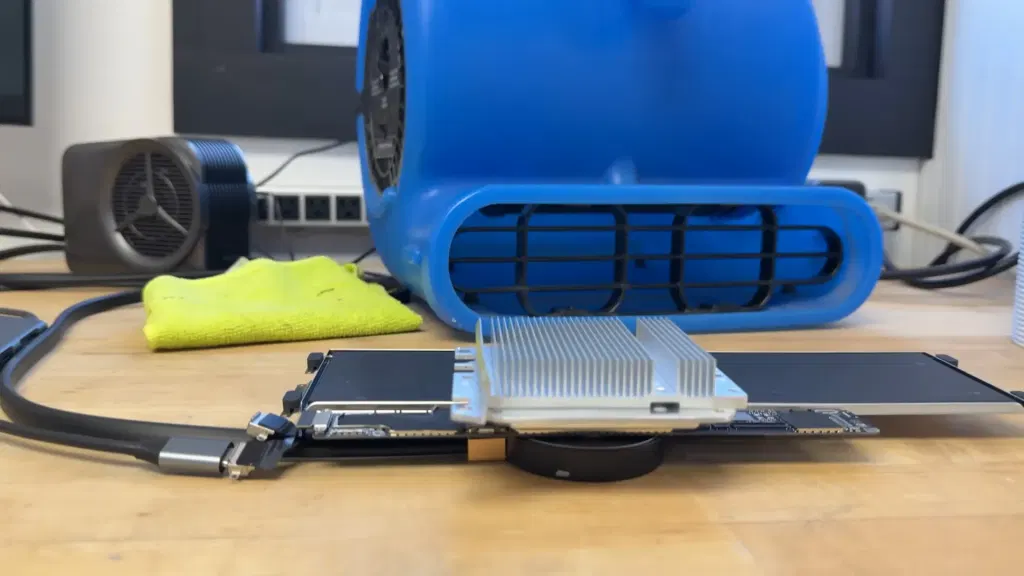
The article discusses the performance enhancement of the MacBook Neo through advanced cooling techniques. By utilizing a combination of phase-change thermal paste and a peltier cooler, significant improvements in processing power were achieved. Despite these advancements, the setup remains impractical for everyday use, focusing solely on maximizing speed.
- ▪The MacBook Neo suffers from thermal throttling like many mobile devices.
- ▪Using advanced cooling methods, performance can be increased significantly, achieving 41.47% higher Cinebench scores.
- ▪The setup described is impractical for daily use, as it removes the logic board and employs heavy cooling equipment.
Hackaday files mainly under tech. We currently carry 245 of its stories.
Story provenance
Source · retrieval · rights · ranking — open for full record
inspect →
Story provenance
Attribution is not the same as permission. This drawer separates discovery metadata, excerpts, WeSearch-generated summaries, reuse status, and whether the publisher receives the visit. Nothing here claims a legal grant the publisher has not made.
Record
| Original publisher | Hackaday |
| Canonical URL | https://hackaday.com/2026/05/20/unlocking-the-true-power-of-a-macbook-neo-by-cooling-it/ |
| Publication time | Thu, 21 May 2026 05:00:48 +0000 |
| Retrieval time | 2026-05-21T05:05:03.495Z |
| Last seen | 2026-05-21T05:05:03.495Z |
| Headline source | Publisher (no WeSearch rewrite) |
| Excerpt source | publisher body |
| Excerpt method | First ~120 words (~800 chars) of extracted publisher body, fair-use limited. |
| Summary | WeSearch · cerebras-chat (WeSearch summarizer) |
| Summary source text | contentText |
| Citation coverage | Summary is a WeSearch-generated derivative; primary citation is the original publisher URL. |
| Cluster | 6dz-HiTkzpoq |
| Cluster logic | Grouped by semantic title/content similarity across sources within a rolling window. Same-publisher template collisions are excluded from coverage comparison. |
| Ranking reason | Story pages are not engagement-ranked. Hub feeds use recency, with optional source-diversified chronological ordering (cap consecutive stories per source). No personalized ranking. |
| Publisher visit | Yes — open original |
| Substitutes article? | No — link-out required for full text |
Rights status (four layers)
WeSearch handling by dimension
| Indexing | May the item be indexed (stored, ranked, made findable)? | Allowed |
| Snippet | May a short excerpt of the publisher's text be shown? | Allowed |
| AI summary | May WeSearch generate its own short summary of the article? | Limited |
| Retrieval / RAG | May the content be exposed for third-party retrieval-augmented generation? | Not asserted |
| Model training | May the content be used to train AI models? | Not asserted |
| Commercial reuse | May the content be reused commercially? | Not permitted |
Basis: Derived from the published RSS/Atom feed. Contact: [email protected]. Reviewed: 2026-07-24.
Opening excerpt (first ~120 words) tap to expand
Unlocking The True Power Of A MacBook Neo By Cooling It No comments by: Tyler August May 20, 2026 Title: Copy Short Link: Copy Mobile devices generally have one Achilles’ heel when it comes to computing power: thermal throttling. Outside of bulky desktop and server systems, chips have to run at a fraction of their true potential to keep from cooking themselves to death. The MacBook Neo, with its iPhone-derived A18 processor, is no exception. Since Apple’s budget offering first came out, though, there’s been an arms race on the benchmark sites to see just how far you can push it, and [Salem Techsperts] briefly claimed the accolade of ‘fastest MacBook Neo’, and of course provided a video showing how it’s done. It’s hardly rocket science: you cool the chip.
…
Excerpt limited to ~120 words for fair-use compliance. The full article is at Hackaday.
Discussion
0 commentsMore from Hackaday