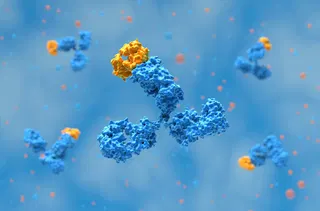
Collective intelligence for AI-assisted chemical synthesis

A new computational framework called MOSAIC has been introduced to assist chemists in chemical synthesis. It utilizes collective knowledge from millions of reaction protocols and has achieved a 71% success rate in experimental validations. This model not only facilitates the realization of new compounds but also aids in discovering new reaction methodologies.
- ▪MOSAIC is built on the Llama-3.1-8B-Instruct architecture and trains 2,498 specialized chemical experts.
- ▪The framework delivers reproducible and executable experimental protocols with confidence metrics for complex syntheses.
- ▪MOSAIC has successfully realized more than 35 new compounds across various fields, including pharmaceuticals and materials.
Hacker News (AI / LLM) files mainly under ai. We currently carry 3,306 of its stories.
Story provenance
Source · retrieval · rights · ranking — open for full record
inspect →
Story provenance
Attribution is not the same as permission. This drawer separates discovery metadata, excerpts, WeSearch-generated summaries, reuse status, and whether the publisher receives the visit. Nothing here claims a legal grant the publisher has not made.
Record
| Original publisher | Nature |
| Canonical URL | https://www.nature.com/articles/s41586-026-10131-4 |
| Publication time | Tue, 19 May 2026 15:01:14 +0000 |
| Retrieval time | 2026-05-19T15:14:57.682Z |
| Last seen | 2026-05-19T15:14:57.682Z |
| Headline source | Publisher (no WeSearch rewrite) |
| Excerpt source | publisher body |
| Excerpt method | First ~120 words (~800 chars) of extracted publisher body, fair-use limited. |
| Summary | WeSearch · cerebras-chat (WeSearch summarizer) |
| Summary source text | contentText |
| Citation coverage | Summary is a WeSearch-generated derivative; primary citation is the original publisher URL. |
| Cluster | LPqUx1m4kmuh |
| Cluster logic | Grouped by semantic title/content similarity across sources within a rolling window. Same-publisher template collisions are excluded from coverage comparison. |
| Ranking reason | Story pages are not engagement-ranked. Hub feeds use recency, with optional source-diversified chronological ordering (cap consecutive stories per source). No personalized ranking. |
| Publisher visit | Yes — open original |
| Substitutes article? | No — link-out required for full text |
Rights status (four layers)
WeSearch handling by dimension
| Indexing | May the item be indexed (stored, ranked, made findable)? | Allowed |
| Snippet | May a short excerpt of the publisher's text be shown? | Allowed |
| AI summary | May WeSearch generate its own short summary of the article? | Limited |
| Retrieval / RAG | May the content be exposed for third-party retrieval-augmented generation? | Not asserted |
| Model training | May the content be used to train AI models? | Not asserted |
| Commercial reuse | May the content be reused commercially? | Not permitted |
Basis: Derived from the published RSS/Atom feed. Contact: [email protected]. Reviewed: 2026-07-24.
Opening excerpt (first ~120 words) tap to expand
Article Published: 19 January 2026 Collective intelligence for AI-assisted chemical synthesis Haote Li ORCID: orcid.org/0000-0002-8146-50661 na1, Sumon Sarkar1 na1, Wenxin Lu ORCID: orcid.org/0000-0001-6388-77431, Patrick O. Loftus ORCID: orcid.org/0009-0009-5952-10901, Tianyin Qiu ORCID: orcid.org/0000-0002-3490-84691, Yu Shee1, Abbigayle E. Cuomo1, John-Paul Webster1, H. Ray Kelly ORCID: orcid.org/0000-0003-3811-06622, Vidhyadhar Manee2, Sanil Sreekumar2, Frederic G. Buono2, Robert H. Crabtree ORCID: orcid.org/0000-0002-6639-87071, Timothy R. Newhouse ORCID: orcid.org/0000-0001-8741-72361 & …Victor S.
…
Excerpt limited to ~120 words for fair-use compliance. The full article is at Nature.
Discussion
0 commentsMore from Nature
![Book of Cron Job [fiction]](/img-proxy?url=https%3A%2F%2Fmedia.nature.com%2Flw1200%2Fmagazine-assets%2Fd41586-026-01716-0%2Fd41586-026-01716-0_52500258.jpg&w=320)