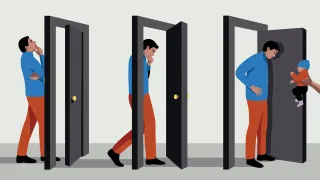
Why Is It So Hard to Be Ordinary?

The article explores the tension between striving for excellence and accepting ordinariness in life, particularly in youth sports. It highlights how societal pressures can lead to dissatisfaction with regular experiences, as individuals often feel compelled to pursue greatness. This struggle between wanting extraordinary achievements and embracing mediocrity is a common human experience.
- ▪Youth sports often reflect a conflict between striving for excellence and enjoying the game.
- ▪Many children participate in sports not for love but due to parental influence.
- ▪Society's relentless pursuit of excellence can overshadow the value of ordinary experiences.
The New Yorker files mainly under culture. We currently carry 75 of its stories.
Story provenance
Source · retrieval · rights · ranking — open for full record
inspect →
Story provenance
Attribution is not the same as permission. This drawer separates discovery metadata, excerpts, WeSearch-generated summaries, reuse status, and whether the publisher receives the visit. Nothing here claims a legal grant the publisher has not made.
Record
| Original publisher | The New Yorker |
| Canonical URL | https://www.newyorker.com/culture/open-questions/why-is-it-so-hard-to-be-ordinary |
| Publication time | Fri, 22 May 2026 10:00:00 +0000 |
| Retrieval time | 2026-05-22T10:02:01.555Z |
| Last seen | 2026-05-22T10:02:01.555Z |
| Headline source | Publisher (no WeSearch rewrite) |
| Excerpt source | publisher body |
| Excerpt method | First ~120 words (~800 chars) of extracted publisher body, fair-use limited. |
| Summary | WeSearch · cerebras-chat (WeSearch summarizer) |
| Summary source text | contentText |
| Citation coverage | Summary is a WeSearch-generated derivative; primary citation is the original publisher URL. |
| Cluster | FMgPmqitzT3q |
| Cluster logic | Grouped by semantic title/content similarity across sources within a rolling window. Same-publisher template collisions are excluded from coverage comparison. |
| Ranking reason | Story pages are not engagement-ranked. Hub feeds use recency, with optional source-diversified chronological ordering (cap consecutive stories per source). No personalized ranking. |
| Publisher visit | Yes — open original |
| Substitutes article? | No — link-out required for full text |
Rights status (four layers)
WeSearch handling by dimension
| Indexing | May the item be indexed (stored, ranked, made findable)? | Allowed |
| Snippet | May a short excerpt of the publisher's text be shown? | Allowed |
| AI summary | May WeSearch generate its own short summary of the article? | Limited |
| Retrieval / RAG | May the content be exposed for third-party retrieval-augmented generation? | Not asserted |
| Model training | May the content be used to train AI models? | Not asserted |
| Commercial reuse | May the content be reused commercially? | Not permitted |
Basis: Derived from the published RSS/Atom feed. Contact: [email protected]. Reviewed: 2026-07-24.
Opening excerpt (first ~120 words) tap to expand
Open QuestionsWhy Is It So Hard to Be Ordinary?It’s what most of us are, most of the time. Shouldn’t it be enough?By Joshua RothmanMay 22, 2026Illustration by Josie NortonSave this storySave this storySave this storySave this storyYou’re reading Open Questions, Joshua Rothman’s weekly column exploring what it means to be human.My son’s Little League season started not long ago. A few games in, a sign appeared, mounted to a chain-link fence at the ballpark. Under the heading “Please Remember,” it offered a five-point list:These are KIDS.This is a GAME.Coaches are VOLUNTEERS.Umpires are HUMAN.No scholarships will be handed out today.The sign concluded, “Thank you”—without, I noticed, a chipper exclamation point.
…
Excerpt limited to ~120 words for fair-use compliance. The full article is at The New Yorker.
Discussion
0 commentsMore from The New Yorker